For the last week of Tech this year our 8th topic was about plants. We first talked about how plants grow and the structure of a plant. We talked about what plants need, such as Carbon Dioxide, Water, and Sunlight. We talk about how each need works and how it happens. We then got 10 leaves from the school, all different leaves. We categorized them using a table talking about their size, texture, colour, and pattern. We talked about how big the leaf is, how it feels, the colour of the leaf and the pattern on the leaf.
Showing posts with label Science. Show all posts
Showing posts with label Science. Show all posts
Friday, 27 November 2020

Thursday, 24 September 2020
The 3 Laws of Inertia
LI: to learn about Inertia
This week we learnt about Inertia, Inertia is a force of physics. There are 3 laws of Inertia. The three are Inertia of Rest, Inertia of Motion and Inertia of Direction. Inertia is the tendency to resist a change of motion. You experience Inertia all the time, for example when in a car and the car suddenly stops you jerk forward because of the change of velocity or speed. For this activity Lukah, Haylee, Sakina, Pouvi and I worked collaboratively to create this DLO. Something we found interesting was that Inertia was an everyday thing we experienced but we never really noticed.
Friday, 11 September 2020
MRS C GREN
LI: To understand the meaning behind the acronym MRS C GREN
For Reading we continued learning about Science. This week our topic was about Biology. Biology is the study of living organisms. We were learning about MRS C GREN. MRS C GREN is the acronym for the life process of living organisms. We did this activity in our groups and we collaborated together to make this DLO (Digital Learning Object).
MRS C GREN stands for:
Movement - moving around
Respiratory - breathing
Sensitivity - being sensitive
Cells - micro organisms that make up organisms
Growth - the process of growing
Reproduction - making an offspring
Excretion - removing waste from the body
Nutrition - nutrients for the body
Thursday, 10 September 2020
Science is Empirical
LI: To look for evidence in the data/an image and infer what might be happening
https://www.wevideo.com/view/1825414400
For Reading we were learning more about Science, this week our topic for Science was Biology. Biology is one of the 3 main branches of science. Biology is the study of living organisms. But this week we focused on what science is. Science is Empirical, which means science is based on observations. Coming off of that we started learning more vocab related to what Empirical meant. In the video we explained the meaning of the vocab we learnt, and explained the task we did.
Friday, 4 September 2020
Science Equipments
LI: to learn about the difference science equipments
At Tech we learnt about many of the science equipments, so we made a DLO about each of the science equipments. The equipments we were learning about were mainly tools for chemistry. The many science equipments we were learning about were Test Tubes, Conical Flask, and many more. It was really cool doing this because I got to learn about the tools people used to learn about different substances and chemicals.
Wednesday, 19 August 2020
Mary Anning
LI: to learn more about our science subjects through people

For Reading our task was to study a scientist from each of the 4 main science branches, which are Physics, Chemistry, Biology, and Astrology/Geology. I was studying Mary Anning who studied Geology, and is a huge icon in the science community. My DLO shows the 5Ws and H being answered about Mary Anning. This task was really fun to do, again because I really got to learn about Geology through Mary Anning. Mary Anning is such a huge icon because of her huge discoveries. One of them being the discovery of the Jurassic fossils.
Charles Darwin
LI: to learn more about our science subjects through people

For Reading our task was to study a scientist from each of the 4 main science branches, which are Physics, Chemistry, Biology, and Astrology/Geology. I was studying Charles Darwin who studied Biology, and is a huge figure in the science community. My DLO shows the 5Ws and H being answered about Charles Darwin. This task was really fun to do, again because I really got to learn about Biology through Charles Darwin. Charles Darwin came up with the theory that all species of life came from a common ancestor, which has become a foundational concept in the community of science.
Alfred Nobel
LI: to learn more about our science subjects through people

For Reading our task was to study a scientist from each of the 4 main science branches, which are Physics, Chemistry, Biology, and Astrology/Geology. I am studying Alfred Nobel who studies Chemistry, and is a massive figure in the revolution of science. My DLO shows the 5Ws and H being answered about Alfred Nobel. This task was really fun to do, because again I really got to learn about Chemistry through Isaac Newton. I got to study Chemistry by reading the formula of how Alfred Nobel invented the dynamite, which was a huge contribution to science.
Isaac Newton
LI: to learn more about our science subjects through people

For Reading our task was to study a scientist from each of the 4 main science branches, which are Physics, Chemistry, Biology, and Astrology/Geology. I am studying Isaac Newton who studies Physics, and is a huge person in the science community. In my DLO it showcases the milestones of Isaac Newton, and some interesting facts about him. I've laid it out in a kind of way, showcasing the main parts of his life, which I thought was a good idea.
This task was really fun to do, because I really got to learn about Physics through Isaac Newton. I got to study Isaac Newton, as well as some Physics.
Thursday, 6 August 2020
Science Summary | Reading
LI: to summarise the information.

This DLO is highlighting our summary about what we know about science. In our groups, we have been sharing our ideas on posted notes and found the key words which we then wrote a summary about what science is. To then create a summary about the topic. We needed to skim and scan for key vocabulary to create this DLO. We also had to join our ideas together to create a more efficient idea.
We used our new question dice to help us construct some questions we want to find more about. The three questions we made using the dices were:
- When did science start?
- How will science progress in the future?
- Who was the first scientist?
Wednesday, 22 July 2020
Experimenting with Ultaviolet light
LI: to find the most effective UV filter
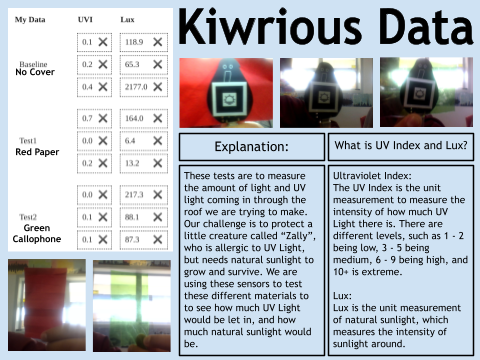
Learning Space 2 has been trialling the the electronic sensors for the Kiwrious kit project. We were working with the Suranga, Sonia, Evan, Dawn, and Yvonne from the AHL at Auckland University. I found that the red paper was the most effective to keep Zally safe from the Ultraviolet light. My DLO will show you about how I did this experiment.
Subscribe to:
Posts (Atom)